Getting across complex ideas can be difficult at the best of times. Summarizing a whole paper in just 90secs sounds impossible.
But we managed to boil down five years of work into just the key concepts to put into this video abstract of our latest Nature Communications paper, which looks at an immunotherapeutic for superbugs.
Hopefully, just like a movie trailer, it sparks an interest to then go on a read the paper. Have you considered a video abstract or graphical abstract for your paper?
Nope, I did not think I could pitch a baseball, let alone design and give a pitch to industry. I had done neither of these before, but now I was taking the plunge and entering the “So you think you can pitch?” 2020 competition held by Monash Biomedical Discovery Institute.
Pitching antimicrobials
Pitching an idea to industry was something I had read about, but never practised. It was something that I endeavoured I would one day do, and hoped more researchers would be doing. Why? Well, it would mean there is change coming for antibiotic development and perhaps the broken antibiotic pipeline is on the mend.
Our immunotherapeutics for superbugs, or any new antimicrobials have a huge uphill battle before reaching our pharmacy’s shelves. This is in part due to the lack of interest from Big Pharma to invest in this area, and is completely understandable when shareholders expect returns on their investments. The research, trials and licensing of new drugs is expensive, and new antibiotics yield less profit than drugs for cancer or chronic conditions. Patients take antibiotics for only a week or two, compared to years for chronic conditions. Plus antibiotics must be used judiciously to avoid overuse and resistance developing. Thus don’t go expecting huge sales either. We have come to expect antibiotics to be cheap, and readily available. We don’t value antibiotics as the life saving medicines that they are. Only 100 years ago ⅓ of deaths were due to simple infections. With discovery of antibiotics mortality has gone down and antibiotics have become a cornerstone of life saving modern medicine. But this is under threat with increasing rates of antibiotic resistance. We do face modern medicine being plunged back into the dark ages as we will get to the stage where there are no antibiotics to left on the pharmacy shelf that are fit for purpose. We are already there for some bacterial infections being resistant to all our antibiotics.
With the risks and lack of profits, why would any commercial developer invest in antibiotics? There are changes happening to lure back investors – market entry rewards, subscription models (think Netflix for antibiotics), public/private partnerships like CARB-X (the Combating Antibiotic Resistant Bacteria Biopharmaceutical Accelerator) and GARDP (the Global Antibiotic Research and Development Partnership). Hopefully with these and further changes pitching antimicrobials to investors will become a common event, and I can put the skills learned during the competition into practise.
I found myself in a Zoom meeting. Nothing unusual for Melbourne in 2020 with Covid19 outbreaks causing lockdowns that resulted in working from home more often than not. But this Zoom meeting was a little different, it brought together four early career researchers that had been selected as finalists in the BDI “So you think you can pitch competition?”. Joining us were four mentors who aimed to share their knowledge on pitching to industry. The finalists had been given written directions and came to the meeting with what we thought was a pitch of our science to a potential investor. Let’s just say we had a lot to learn. With our amazing mentors providing personal guidance over a few Zoom meetings, our talks turned into pitches. To see how our pitches changed from that first meeting to what was presented at the final Industry showcase was inspirational. A huge thank you to our pitch mentors for imparting their knowledge, it would not have been possible without you.
I learnt so much from developing my own pitch as well as observing the changes in the pitches of the other participants. It was these worked examples, personal feedback, and practised use of the skills from one Zoom meeting to the next that really changed, although challenged, our thinking.
Pitch Mentors:
Dr Andrew Ellisdon, Monash BDI
Mr Julian Vultaggio, Associate Commercialisation Manager at Monash Innovation
Mrs Sian Slade, Consultant Health Equity
Dr Tracey Brown, Global director of clinical operations for Telix
Pitch Finalists:
Dr Sri Ramarathinam
Dr Sarah Lockie
Dr Amlan Chakraborty
Dr Jennifer Payne
The Covid19 pandemic meant that the BDI Industry showcase event that was to be host to the “So you think you can pitch?” competition was moved online. Our talks were pre-recorded at Monash University’s MicroStudio. I found this more nerve racking than if I was giving the talk in person. The talk would live on for prosperity, recorded for all to see. The little hiccups, and mistakes would be recorded, as we only had two takes to get the pitch right. No going back and doing over to try and simulate a real-life event. So, it had to be good. Talking to the other finalists afterward revealed this to be a common feeling – in front of the camera was much more nerve racking than live on stage.
Our judges had a hard task of selecting a winner and a runner up from the four pitches filled with exciting science that is happening at the BDI.
Dr Cathy Drinkwater, Director of Project Management, BioCurate Pty Ltd
Dr Rob Crombie, Managing Director of Concept2Clinic Consulting
Dr Siro Perez, Life Sciences team of IP Group Australia
The audience also had their say with selecting the people’s choice winner on the night. Prize money was up for grabs thanks to the event sponsors of MTPConnect, Medical Research Commercialisation Fund, and Monash BDI. You can watch all 4 finalists pitches below.
Who do you think can pitch?
Dr Jennifer Payne’s pitch Fatal attractants: immunotherapeutics to prevent the next global health crisis’. Dr Payne took out first prize and the People’s Choice prize.
Dr Sri Ramarathinam’s pitch ‘Scan the barcode: Detecting and validating targets in cancer’. Dr Ramarathinam took out second place.
Dr Sarah Lockie’s pitch ‘Targeting hunger circuits in the brain to treat cancer cachexia?’
Dr Amlan Chakraborty’s pitch ‘SNDC – a new hope for fish out of water.’
Want to compete?
Are you at Monash BDI and want to improve your science communication and pitching skills? Find out more about this competition and enter by contacting Industry Engagement at the Monash Biomedicine Discovery Institute. When I competed this was run by the Director of Industry Engagement Associate Professor Sheena McGowan. Good luck!
A huge thank you to Monash BDI Industry engagement, the mentors, judges, finalists, and sponsors for making this event possible.
Want to follow in my footsteps? Learn more about this hikehere. I practise leave no trace principles. Please respect the environment and learn how to do the same on your next adventure here.
July… Winter in Melbourne brings short cold days… Covid-19 lockdown 2.0… No wonder the doom and gloom was starting to get to me. Lucky for me a short walk around the local Valley reserve in Mt Waverly brought some light back in, with the bush putting on a lovely little show. This reserve is a great oasis in the sea of houses – the beginnings of a creek, a wetland area, with some great moss, plenty of wildlife, and not many people. The short loop track, is an easy grade, with a little uneven ground on the woodland trail. I will have to come back with our greyhound April, as dogs are allowed on lead, and there are some great facilities. Already planning a picnic in the wonderful native grasslands on the next sunny Covid lock down free day.
The nodding greenhood, Pterostylis nutans, showing off its parrot beak-like flower
What I was surprised to find on my walk was a patch of nodding greenhood orchids, Pterostylis nutans. Also known as the parrot’s beak orchid, a perfect description of the 2.5cm long, ‘nodding’ flower. Orchids have an interesting relationship with microbes. Like all Orchidaceae family members, this greenhood would have had a very close relationship with a fungus during its infancy. Colonisation by a particular fungus can be a matter of life or death of orchids. Without a fungal association at germination, the orchid will have no energy to continue growing as unlike other seeds, the orchid has virtually no energy reserves, relying on the fungal symbiont to provide its nutrition. But even when grown, and can photosynthesises to produce its own energy, the majority of orchids are still reliant on their relationship with a fungus. These root associated fungi provide inorganic nutrition to the orchid – and orchids can supply carbon as “payment” in return for the fungal services. Many of the Australian orchid species are monogamous – having one specific fungal species associated with them. But some orchids, like the Nodding greenhood, often have some action on the side. Though P. nutans, the nodding greenhood partners up with Ceratobasidium spp there are often other fungal species associations as well. This was found back in 2007 by 3 Australian based scientists, through DNA extraction of the roots of P. nutans plants from across the east coast of Australia.
I stumbled on this park as I was delivering contact-free cake to celebrate a PhD student submitting their thesis. During Covid we have been celebrating the small things as well as the larger wins such as a thesis submission. Hoping to bring a taste of home to the celebration I tried my hand at the Lithuianian, Simtalapis. Paper-fine yeast dough, layered with butter (and more butter) wrapped around ground poppy seeds with sultanas. A test in patience and willpower – grinding 400g of poppy seeds is an afternoon effort when your grinder is a hand-cranked coffee grinder that fits 20g of poppy seeds at a time. Want to make your own Simtalapis? This is the recipe I followed, however I am still not sure where all the butter goes.
Celebrate the wins, and enjoy the small things!
Have you looked at the trunks of trees lately? The scars tell stories of the past or hold a city of creatures in the bark.
Kulin nation scarred tree: This red gum has a distinctive shaped scar, where the bark was removed to possibly construct a canoe. Moved from its original location in Glen Waverly, due to the expansion of Springvale Rd in 1965.
Have you looked around at your feet? Greenhood orchids nodding in a bed of moss.Have you inspected the bushes? What creatures do they hold? Hover fly dusted in pollen on the spirals of hakea flowers
Acacias bursting into bloom
Jenn masked up amongst the gums at Valley reserveThe tracks in Valley Reserve
Adventures of a clumsy National Geographic Explorer person in Far North Queensland (Part 3): Can we eat it?
The rainforest is full of a dazzling array of forests fruits and seeds. Through the course of this research my team and I have collected, collated, identified and cleaned many, many seeds much to the amusement of folks that share our accommodation space. The fascination with rainforest seeds seems to be shared by many people and while we work de-fleshing and de-maggotting seeds, we receive questions, and comments in question form, from curious by-standers. “Is that bush tucker”, “Is that edible”, “Have you eaten that”, “That smells like a plum”, “They look like olives”. I think these questions are quite revealing of the human-centric way we interpret our world as they can all be pretty well summed up in one question: “Can I eat that?”
From front going clockwise: brown seeds with dark red of Myristica insipida (native nutmeg); ‘sweet-potato chip’ seeds of Cardwellia sublimus, blue pune-sized seeds of Endiandra Sankiana (a laural); small purple seeds of Litsea leefeana (also a laural); red seeds of a podocarp (a species of conifer); Plum sized seeds of Crysophyllum sp.; olive-sized seeds of Cryptocaryra angulata (yet and other laural), pod full of winged seeds of a Lomatia tree; Mahogony coloured seeds of Garcinia endophloem (a member of the mangosteen family).
The answer to that question?
No.
No, you cannot because these are my research and we’ve spent many days collecting them.
No, you cannot because I am not a “Dr of Bush Tucker” (although I wish I knew about that sort of thing)
And No, you cannot because while I don’t know if this fruit is edible, I do know that 80 % of the fruits in the Australian rainforest are poisonous.
But there’s so many more interesting things to know about seeds beyond whether or not you can eat them. We might ask: “what’s the reason for the wide variety of colour and form?” or we might ask “who eats them?”. Sometimes these questions are intimately entwined.
Colour, nutrition and a trick of the light:
Many seeds cloak themselves in colour to attract seed disperses. Red is quite popular being particularity attractive to birds. The seeds of the native nutmeg, Myristica insipida, have an underwhelming brown-yellow casing but the seed itself is wrapped in deep red, highly nutritious, aril (below left). The aril attracts disperses and can also be dried and powdered to produce mace.
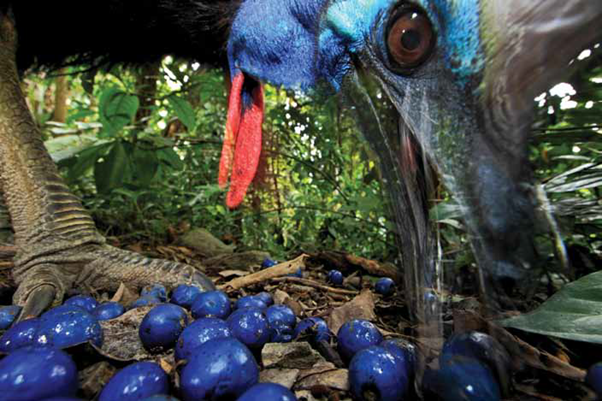
In contrast, the enigmatic elocarpus or blue quandong seed (right; photo from Harms & Green, 2014) are blue to a point where they are iridescent yet the skin of these friut does not contain much in the way of nutritional value. Nor does it contain a single molecule of blue pigment!
The Pollia condensata fruit from Africa performs that same trick, an eye-catching iridescent blue, more intense than that of any previously described biological material, created without the aid of blue pigment (seriously click the link it’s a beautiful fruit).
What is actually occurring on the skin of these seeds is a complex bending and refracting of white light to create blue iridescence. This is achieved by taking lines of cellulose (the basic building block of all plant matter) called microfibrils and arranging these lines side-by-side into planes. The planes of microfibrils are then in turn arranged in helicoid stacks. The complex architecture refracts light creating an intensely iridescent blue. This is much the same process that creates the iridescence seen in the blue wing of the Papilo ulessus butterfly which gently drifts through the canopy above us as we work. It seems like a complicated process just to make blue, but the aim of these seeds is to trick seed disperses (birds and critters) into taking the seed for little or no nutritional return. To pull off such a trick I guess you need to be a pretty special looking blue.
Dispersal strategy and staying power
In the rainforest a plant faces an interesting conundrum when it come to the choice of seed that it creates. We know that seeds that disperse farther away from their parent tree, and their brother and sister seedlings, tend to have a better chance of surviving (see post 2) so there is an advantage to having a guaranteed dispersal strategy. This is exactly what winged seeds do. They use the wind to carry seeds far from the parent tree. In the image at the top of this post there are two winged seed morphologies. The flaky brown seeds, which an onlooker quite astutely described as ‘sweet-potato chip’ seeds, see-saw clumsily down to the forest floor. These are the seeds of Cardwellia sublimus. The pod full of winged seeds with yellow dust over the seed (it’s not pollen) fly like helicopters through the under-story. These are the seeds of a Lomatia tree.
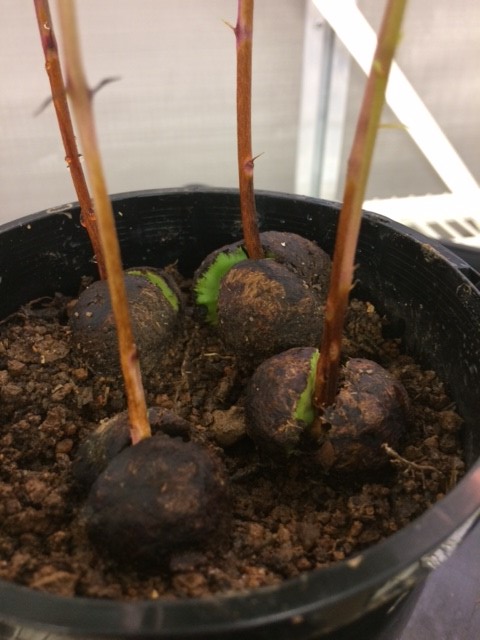
There are many tree species with winged seeds in rainforests, but by and large rainforest seeds take the form of large fleshy fruits, many of which contain one seed per fruit. When these seeds leave the mamma tree, their nursery ground immediately rises to meet them with a resounding ‘thunk’. That is, they pretty much fall straight down. They might roll down the hill a bit if the parent tree is growing on a steep enough slope. But largely there is not much dispersal happening during the journey from canopy to ground. So why are so many rainforest tree species sacrificing their dispersal ability in favour of these mighty conkers? It seems like a lot of energy must go into making such large seeds. And there’s the answers. Energy. When you cut open one of these seeds, you’ll find two large fleshy halves. These are actually the seeds first leaves. They look nothing like any of the leaves that will follow, they are not true leaves, they have special name ‘cotyledons’ and they are energy reserves.
Cotyledons of a winged seed are thin and designed to photosynthesize (above left); Golf-ball sized fleshy cotyledons from large seeds remain at the base of the seedling with a very minimal for photosynthesis (green area).
The cotyledons of winged species are thin, emerge and disappear quickly and are almost entirely used for harvesting light into energy. In contrast the cotyledons of large-seeded species hang around for a long time but contribute little towards photosynthesis – some even stay encased in their seed coat. These cotyledons are energy reserves. The idea is that in a rainforest for a seedling to survive and become a tree it needs to persist for a long time. It needs to persists even though there is extremely low light, it needs to persist even if leaf litter covers its photosynthetic leaves and it needs to persists -and re-sprout – if its shoot gets eaten. It may need to wait a very long time because things the rainforest under-story happen sloooowly, so having a storage reserve confers a selective advantage (Green and Juniper, 2004).
‘How slow?’ I hear you ask. Well, for more then 50 years ecologists have painstakingly tracked the growth of thousands of seedlings, sapling and trees at Davies Creek: in that 50 years some plant have only grown few feet (Harms and Green, 2014).
So it seems survival in the dark is the order of the day for rainforest seedlings and large seeds which come with a packed lunch of energy reserves are one way to help the seed manage this suppressive environment. In terms of dispersal – not all is lost – these seeds simply outsource the job. The fleshy, and often fragrant, outer coverings of the fruit attract cassowaries and other native animals such as the white tail rat which will redistribute the seeds around the forest. The rats create caches of seeds that if forgotten long enough will germinate, and cassowaries leave steaming seed patties in the wake of their wanderings. Dispersing seeds, encouraging diversity and making seed collection for this ecologist as simple as poo-pie.
Ask not: Can you eat that seed? | Ask: What can that seed tell you?
Dr Jen Wood @JW_ilikedirt
All thoughts and photos by Jen Wood unless otherwise indicated
Green, P.T. and Juniper, P.A. (2004). “Seed–seedling allometry in tropical rain forest trees: Seed mass-related patterns of resource allocation and the ‘reserve effect’.” Journal of Ecology 92(3): 397-408.
Adventures of a clumsy National Geographic Explorer person in Far North Queensland (Part 2): Why are rainforests so diverse?
If you know one thing about rainforests, it’s probably that you know they are diverse. You’d be right. But do you know why they are so diverse?
Less than 1 square kilometer of rainforest can harbour more plant diversity than one million square kilometers of temperate forest (Wright 2002, Wood et al. 2019).
That’s really diverse. But, why are rainforests so diverse?
The answer is simple: we don’t know.
As far as ecosystems go, rainforests are uncommon. Most forest ecosystems around the world typically have only a few dominate canopy species: Conifer forests are monodominant (only have one dominate species); southern Australian bushland will typically have two maybe three dominant canopy species (for example a eucalypt and one or two acacia species). In contrast, just one hectare of rainforest can harbour up to 100 different species of canopy tree, all jostling for light but equally finding space.
Not just a sea of green: look closely at a rainforest canopy and you will see a wide variety of colour (albeit green colours), form, and shape.
The immense plant and animal diversity rainforests harbour provide crucial ecosystem services (air and water filtering, climate regulation etc.), attract economic benefits though ecotourism (Prideaux 2014) and continue to contribute to the discovery of new therapeutics (Balunas and Kinghorn 2005, Perigo et al. 2016) and novel species (Jay et al. 2016, McDonald et al. 2016). Clearly rainforest diversity is important – we’ve known this for a long time – so how is it we still don’t understand what makes rainforests so diverse?
Part of the puzzle is that in the rainforest some tree species are prolific seed producers, while other species are far less prolific. Why then, don’t the prolific seed producers come to dominant the canopy? Or at least, why don’t we see dense stands of one tree species within the rainforest – localized dominance if you will?*
Actually we do see dense assembles of one plant species, when we look among the seedlings, but something happens between seedling and mature rainforest that thins the herd and results in an increase in diversity. In the 1970s two ecologists working independently, Daniel Janzen and Joe Connell (who established and was working on the same field site we are using today), realised that diversity could be maintained if there were some mechanism that stopped common species from growing and coming to dominate whilst allowing rarer species to grow unchecked. A balancing effect that evens the odds among tree species within the community. We refer to this ‘force’ as non-random mortality (because it non-randomly kills off common species but not the rare species) and it has become the cornerstone rainforest diversity research and is encapsulated in what is now known the Janzen-Connell hypothesis.
*localized dominance is actually a thing that happens in rainforests, but not often, and its an area of research interest in its own right.
Who or what is causing non-random mortality in rainforests?
Countless studies have tried to understand patterns of non-random mortality in rainforests. Whilst vertebrate seed/seedling-predators (Theimer et al. 2011, Kurten and Carson 2015) and insects (Swamy and Terborgh 2010, Bagchi et al. 2014) have been proposed as the cause of non-random seedling mortality, by far the most convincing body of evidence implicates soil-microbial pathogens (Augspurger 1983, Augspurger and Kelly 1984, Gilbert et al. 1994, Bell et al. 2006, Bagchi, Gallery et al. 2014). Which brings me to why we are here doing research supported by the National Geographic Society. Whilst microbes have been inferred as the cause of non-random mortality, very few studies have dug that bit deeper (pun intended) to investigate what make these soil communities tick. Our research aims to look at these rainforest soil microbial communities and see what they are doing.
So how do tiny microbes shape entire ecosystems?
Non-random mortality seems to be related to one of two things: the distance of a seedling from the mamma tree (this is distance dependent mortality) or the density of the seedling patch (density-dependent mortality). The idea behind microbial distance-dependent mortality is that many prolific seed producers create large seeds that fall straight down. If the parent tree harbors a host-specific pathogen reservoir in their root-zone then seedlings germinating close to their parent-tree are more exposed to pathogen attack than a seedling that germinates farther away. In this way the seedling from prolific seed producers are rapidly thinned. Microbial density-dependent mortality is thought to occur due to locally abundant seedlings (i.e. seedlings germinating in dense assemblages) attracting a higher pathogen load than rarer seedlings that germinate in isolation.
That’s some pretty heavy science thoughts. But the key points are we think soil microbes can create rainforest diversity, quite literally, from the ground up. If we can understand how they do this – and what they need to do this – then our odds of conserving these biodiversity hot spots in the face of a changing climate will dramatically increase.
Rainforest biodiversity. It’s a thing.
Rainforest biodiversity| so important | still a mystery |maybe microbes hold the key
Dr Jen Wood @JW_ilikedirt
Augspurger, C. K. (1983). “Seed dispersal of the tropical tree, platypodium elegans, and the escape of its seedlings from fungal pathogens.” Journal of Ecology 71(3): 759-771.
Augspurger, C. K. and C. K. Kelly (1984). “Pathogen mortality of tropical tree seedlings: Experimental studies of the effects of dispersal distance, seedling density, and light conditions.” Oecologia 61(2): 211-217.
Bagchi, R., R. E. Gallery, S. Gripenberg, S. J. Gurr, L. Narayan, C. E. Addis, . . . O. T. Lewis (2014). “Pathogens and insect herbivores drive rainforest plant diversity and composition.” Nature 506(7486): 85-88.
Balunas, M. J. and A. D. Kinghorn (2005). “Drug discovery from medicinal plants.” Life Sciences 78(5): 431-441.
Bell, T., R. P. Freckleton and O. T. Lewis (2006). “Plant pathogens drive density-dependent seedling mortality in a tropical tree.” Ecology Letters 9(5): 569-574.
Gilbert, G. S., R. B. Foster and S. P. Hubbell (1994). “Density and distance-to-adult effects of a canker disease of trees in a moist tropical forest.” Oecologia 98(1): 100-108.
Jay, K. R., Z. R. Popkin-Hall, M. J. Coblens, J. T. Oberski, P. P. Sharma and S. L. Boyer (2016). “New species of austropurcellia, cryptic short-range endemic mite harvestmen (arachnida, opiliones, cyphophthalmi) from australia’s wet tropics biodiversity hotspot.” ZooKeys 2016(586): 37-93.
Kurten, E. L. and W. P. Carson (2015). “Do ground-dwelling vertebrates promote diversity in a neotropical forest? Results from a long-term exclosure experiment.” BioScience 65(9): 862-870.
McDonald, K. R., J. J. L. Rowley, S. J. Richards and G. J. Frankham (2016). “A new species of treefrog (litoria) from cape york peninsula, australia.” Zootaxa 4171(1): 153-169.
Perigo, C. V., R. B. Torres, L. C. Bernacci, E. F. Guimarães, L. L. Haber, R. Facanali, . . . M. O. M. Marques (2016). “The chemical composition and antibacterial activity of eleven piper species from distinct rainforest areas in southeastern brazil.” Industrial Crops and Products 94: 528-539.
Prideaux, B. (2014). Rainforest tourism, conservation and management: Challenges for sustainable development.
Swamy, V. and J. W. Terborgh (2010). “Distance-responsive natural enemies strongly influence seedling establishment patterns of multiple species in an amazonian rain forest.” Journal of Ecology 98(5): 1096-1107.
Theimer, T. C., C. A. Gehring, P. T. Green and J. H. Connell (2011). “Terrestrial vertebrates alter seedling composition and richness but not diversity in an australian tropical rain forest.” Ecology 92(8): 1637-1647.
Wood, J. L., P. T. Green, J. J. Vido, C. Celestina, K. E. Harms and A. E. Franks (2019). “Microbial communities associated with distance- and density-dependent seedling mortality in a tropical rainforest.” Plant Ecology.
Wright, S. J. (2002). “Plant diversity in tropical forests: A review of mechanisms of species coexistence.” Oecologia 130(1): 1-14.
All thoughts and photos by Jen Wood unless otherwise indicated
Adventures of a clumsy National Geographic Explorer person in Far North Queensland (Part 1): Access denied
It’s day one of field work. We are cruising along a dirt road in Davies Creek National Park en route to our field site deep within the rainforest that constitutes the Eastern half of the park. We drive through a landscape of lemon-scented gums dotted with flowering grass trees, then into spindly casuarina forests which give way briefly to towering stands of eucalyptus grandii before plunging into pristine rainfor– … a road closed sign?!
Clearly, we didn’t literally plunge into the road closed sign. But blocking the road to our field site and all the work we had planned to do sat a simple, obstinate sign reading ‘Entry prohibited’. Bugger.
Photo credit: Josh Vido, Research associate
The road to our field site, the Davies Creek long-term rainforest plot, is closed because there is an active bush fire. At this point, I am thinking back to doing the risk assessment for this trip and recall getting to the ‘risk of bush fire’ section and thinking ‘lol, rainforests don’t burn’. Yet here we are.
Fire is a part of the Australian landscape and integral to the ecology of many of our ecosystems. Many species are fire adapted to the point that fire is necessary for their survival: the giant mountain ash forests of southern Australia are re-invigorated with new life. After fire passes through, swallowing the adult trees, the accumulated seed bank, which may not have germinated for several decades, springs to life creating a new stand of mountain ash. This explains why the ghostly trunks of mountain ash all adhere to a regulation size which makes these forest so enigmatic. Many species of acacia have a similar life strategy and if you happen upon a stand of acacia all of the same apparent age, a savvy ecologist can estimate the time since the last fire passed through. The pods of banksia species remain on the tree, clamped tightly shut with the next generation of seeds safely locked inside until the heat from a passing bush fire causes them to snap open, spraying the ground with fresh seeds ready to germinate in the now competition-free landscape (Huss et al. 2019). This phenomenon is called serotiny. The list trees species in Australia with adaptations to survive and work in concert with bush fire goes on. This makes sense, unlike animals, trees can’t get out of the way of a fire so they need to find a way to work with it.
Above: White trunks of fire-adapted Mountain Ash from Otway National Park (left). Banksia pods in the Blue Mountains near Katoomba (right).
Looking around the charred remains of the landscape, while we wait for a ranger to arrive to confirm the whether the road to our study site is/is not closed, I am reminded that not all animals are made equal when is comes to escaping a fire. For example, what chance does a land-snail have? No legs, no wings, no burrow, no-where to go.
Above: the shells of native land snails litter the ground after a small grass fire has passed through Davies Creek National Park
Snails and other leaf-litter dwelling critters provide crucial ecosystem services, reincorporating carbon from leaf litter into the soil. Perhaps the best adaptation these animals have to cope with fire is to be most active when fire is least likely to occur: in winter or in the wet season (depending where you live in Australia). Microbes are among the list of critters integral to soils and soil function that are not going to be fleeing from fire. Whilst lower reaches of the soil may be buffered from the impact of burning, big fires, like the Black Saturday fires that decimated Marysville and King Lake in Victoria in 2009 burnt so hot that PVC piping buried 1 m below the ground, was found melted. Not much could have survived that. So how are soils recolonised after fire? Where does the new generation of microbes and other soil-dwelling critters come from? How long does it take to rebuild these communities?.
Above: Images King Lake National Park landscape recovering from the 2009 bush fires, taken in 2012
Studies on this question may be particularly important when thinking about fuel-reduction burning which typically occurs in winter when the ground is damp. While this is to be sure a safest time to burn-off leaf litter and ensure the fire will remain under control, this is also the time of year that soil microbes – and all the other soil-dwelling critters – are most active. So how is a soil community that gets burnt during summer, when insects and microbes have effectively shut up shop for the year, impacted by fire and is it different from how communities react to being brunt when they are in full swing, defenses down, during the wet? I suspect it matters a lot.
Rainforest soils provide and interesting tangent upon which to take these musings. Rainforests are not meant to burn. In fact, they are notoriously resistant to fire. But as the climate changes some rainforests are becoming dryer (others will become wetter) and they are starting to burn. This year fire brunt 440 ha of sub-tropical rainforest in Lamington national park. There are multiple lines of evidence to suggest that soil microbes have an important role to play in creating the impressive levels of diversity seen in rainforest plant communities. We don’t know exactly which microbes or microbial functions are key to creating plant diversity, but we do know that diversity plant-microbe interactions occur among seedling and small saplings (Green et al. 2014). Given that the entire ecosystem is not fire adapted, it seems likely (to me at least) that the microbes that carry out these processes will not be adapted to fire either. So when a rainforest burns, and it comes time for plants to regenerate and recolonize the space, will the diversity return to the rainforest or will disrupting processes in the soil have profound flow-on effects for the whole ecosystem? We’re optimistic that the research we are here to conduct will in part begin answering this very question. We’ll be looking at how drought impacts microbial soil-function and whether this has flow-on effects for plant-microbe interactions that govern rainforest diversity. Provided, of course, we are able to access our site.
A quick sat-phone call to the local ranger confirms that the road is indeed closed for today due to fire, but we’ll be right tomorrow to access our site. Have a day off.
Fire in Australian rainforests: ecosystems evolved without fire | How does brunt rainforest recover? | How does brunt rainforest microbiology recover?
Dr Jen Wood @JW_ilikedirt
All thoughts and photos by Jen Wood unless otherwise indicated
Green, P. T., K. E. Harms and J. H. Connell (2014). “Nonrandom, diversifying processes are disproportionately strong in the smallest size classes of a tropical forest.” Proceedings of the National Academy of Sciences, USA 111(52): 18649-18654.
Huss, J. C., P. Fratzl, J. W. C. Dunlop, D. J. Merritt, B. P. Miller and M. Eder (2019). “Protecting offspring against fire: Lessons from banksia seed pods.” Frontiers in Plant Science 10(283).
What do neon lights and invisibility cloaks have in common? Well, they could just be the new way forward in the fight against superbugs.
This was the tag line for my FameLab talk (an International science communication competition) I had entered not imagining that I would make the Victorian finals. I had uploaded a 3-min video of my current post doc work and vowed it would not be seen by another soul. Yes, I am embarrassed to put myself in front of a camera, and up on stage in bright lights is scary. But communication is key.
Scientists need to be able to communicate effectively, not just amongst ourselves, but also with a general audience. Science communication training should be a part of every science degree. Why? Well, effectively communicated science means science thrives. This is because it builds support for science, it promotes the relevance to the wider community, and can even help encourage informed decision making. One excellent way to get better is to train and practise. Level up your science communication skills. That’s why I keep putting my hand up for science communication activities.
Jen Payne on stage at the Victorian Finals of FameLab 2019.
I find planning a talk makes you focus on finding simple, more succinct ways to get the essentials of the story across. Along with discovering ways to make abstract concepts a reality for my audience. It focusses my attention on Why does/should it matter to my audience? Why is it important? This is key not just for speaking to a general audience, but very helpful for any communication, e.g. that next grant application, conference talk, or even job interview.
Practising our science communication skills at the Famelab training session at hosted at the Melbourne Museum.
The FameLab experience combines training with practise. The finalist had a day of science communication training from the engaging Emma’s of comm-it. If you get a chance to attend one of their sessions, do yourself the favour and level up your skills. In our training we covered everything from developing a social media and media profile, stage presence, voice control, timing, and how to present to different audiences. The day flew by and in no time, we were being hooked up to microphones to be in front of our judges and audience at the Melbourne Museum.
The disappointing thing for me is that with my nerves I have no idea what the speakers before me said. However, if they are anything like the engaging, and entertaining 3 min performances that followed – you should definitely be part of the audience at the next FameLab near you. Though not the same as seeing the talk, here is what I squished into the 3-min time limit.
“Not long ago I had a UTI. Thinking it a fairly harmless infection I thought I would just drink more water and flush this bad boy.
Audience laughing. I hadn’t considered the need to pause here.
The next day, a trip to the doctor about the pain in my side revealed it had developed into a kidney infection and I started on antibiotics. Two days later I was in emergency with the infection now in my bloodstream, I had sepsis. 3 different antibiotics later and my infection was under control. The bacteria I had was resistant to the first antibiotics tried, but fortunately the other two managed to eradicate the intruder.
Fast forward 30 years and a similar infection could prove deadly – antibiotic resistant superbugs are predicted to kill 10 million per year by 2050. More than cancer.
Pause, and breathe. Let that fact sink in. The silence can be just as powerful as your words.
The cute super villain of my talk- A giant microbe toy of MRSA. If you need your own head here
Let me introduce you to one of these deadly superbugs, this is Staphylococcus aureus- also known as golden staph, or MRSA.
Brings out the MRSA that she has been trying to hide behind her back. Note to self: pick something that is easy to hide next time. Maybe giant sleeves to hide things in would be better.
Though he looks cute, he’s really a supervillain. What I find scary is that as he develops resistance to antibiotics, superbugs like this are also better at hiding and evading our body’s defences – our immune system. They basically have invisibility cloaks.
Shows off his little invisibility cloak. Should have considered the size of this, MRSA is so tiny the audience is not going to be able to see this.
Superbugs like this one are on the rise and their weight is causing the cornerstone of modern medicine to crumble. In part due to no new antibiotics reaching our pharmacy shelves in over 20 years.
Steps across to the other side of stage. My little bit of stage craft worked into the talk.
So, we need new drugs for these superbugs.
Our current antibiotics are basic annihilators – they find the bacteria and acting like a key specifically target a mechanism of the bacteria resulting in their death. But bacteria are constantly getting better at evading both the antibiotics and our immune system. They have changed the locks.
Stepping away from traditional antibiotics that just kill bacteria, I’m creating drugs that assist in getting our immune system back into the fight by uncloaking the superbugs and decorating them in lights.
Steps across to the other side of stage. My little bit of stagecraft worked into the talk.
And it works!
One of our new antibiotics works by stopping this invisibility cloak from forming. This cloak is a layer of proteins on the bacteria surface and by removing it we see the superbugs being found and cleared by our immune system first line responders – cells know as neutrophils.
Why won’t this invisibility cloak come off easily like it has when practising. Wrestles the cloak off the supervillain and stuffs it into her pocket.
Another way we are ensuring the bacteria is found by our immune system is by decorating them in neon lights – these lights are immune beacons that signal our immune system, ensuring these superbugs have nowhere to hide.
Wraps the “neon lights” around the MRSA. Disappointing I didn’t work out a way to make my eppies (1.5 mL tube) stuffed with neon paper actually light up.
So by stripping down and lighting up, we are tackling superbugs in a new way, and hopefully keeping our pharmacy shelves stocked for many years to come. “
Finished! Was that in the 3min time? Did I say what I was intending? They are firing questions at me, think brain, think.
Jennifer Payne explains how dirt contains a plethora of antibiotic compound producing bacteria and why soil can be thought of as a potential pharmaceutical gold mine.
Photo credits: all photos by Jen Wood unless otherwise indicated
Adventures of a clumsy person in far north Queensland (part 2): The white-death fungus
So, when I’m in the rainforest helping with surveys, I tend to spend most of my time looking down. This is partly because I’m on seedling survey duty – and down is where the seedlings are at – and partly because I really am quite clumsy, so I’m watching my footing. But mostly I am looking down because I’m constantly on the lookout for interesting mushrooms, fungi and other tiny critters
But, it turns out I should have been looking up.
Yes, on the forest floor there is every sort of wood-rotting fungi and colorful mushroom but up in the canopy there’s a fungi that has a wonderfully sinister name and modus operandi. It’s called white death and it kills by touching. White death, also known by the somewhat less dramatic name ‘Clavulicium extendens sp. nov.’, doesn’t appear to be a pathogen in the sense that it can’t infiltrate and infect living tissue (Hood and Ramsden, 1999), instead it forms dense white mats of mycelia that gradually cover leaves and branches often smothering smaller trees and saplings (dark, right?).
One of the most interesting things about white death is how it gets around. It appears to be transferred from tree to tree by touch. When a twig covered with white death touches a new tree, the fungus create at attachment pad (see below, center) where the twig and tree contact, binding them together. From there it proceeds to slowly cover the new tree. If you spot an under-story tree with white death on it, look up and more often than not, high up in the canopy, you’ll see that the source of the white death is a twig that has broken away from a taller tree also covered in the fungus. In this way white death leap-frogs from tree to tree down to the forest floor. Interestingly it doesn’t seem to matter what species of tree the fungus comes in contact with. No one knows the true host-range of this fungus (Green, PT , pers comm ).
So what’s this fungi doing so far up in
the canopy and how does it get there? One possibility is that its spores
are wind dispersed up into the canopy. Another possibility is that it
has an animal that carries it around. Why might I think this? Well
typically white death only affects and kills off the tips of a branch –
the twigs and leaves here are small enough to be smothered. If it came
into contact with a thick branch or a tree trunk its growth probably
wouldn’t impact the tree. Yet looking up into the canopy we noticed (at
least once – see above, left) that the highest point of a white death
infection was a broad flat branch, exactly where a bird might perch as
it flits through the rainforest canopy. What a bird would be doing
carrying around fungal spores on their body or in their feces is
anyone’s guess, but other animals have been known to eat fungi and maybe
the infected twigs lying on the ground are a source of protein for some
bird. This is of course wild speculation.
White death fungi: talented disperser | spreads by touch | white creeping death
Dr Jen Wood @JW_ilikedirt
Hood, IA and Ramsden, M (1999) Clavulicium extendens sp. nov (Corticiaceae), a Fungus Spreading on Twigs in Queensland Rainforests. Australian Systematic Botany12, pp 101–107











 microfiles.home.blog
