Adventures of a clumsy National Geographic Explorer person in Far North Queensland (Part 3): Can we eat it?
The rainforest is full of a dazzling array of forests fruits and seeds. Through the course of this research my team and I have collected, collated, identified and cleaned many, many seeds much to the amusement of folks that share our accommodation space. The fascination with rainforest seeds seems to be shared by many people and while we work de-fleshing and de-maggotting seeds, we receive questions, and comments in question form, from curious by-standers. “Is that bush tucker”, “Is that edible”, “Have you eaten that”, “That smells like a plum”, “They look like olives”. I think these questions are quite revealing of the human-centric way we interpret our world as they can all be pretty well summed up in one question: “Can I eat that?”

The answer to that question?
No.
No, you cannot because these are my research and we’ve spent many days collecting them.
No, you cannot because I am not a “Dr of Bush Tucker” (although I wish I knew about that sort of thing)
And No, you cannot because while I don’t know if this fruit is edible, I do know that 80 % of the fruits in the Australian rainforest are poisonous.
But there’s so many more interesting things to know about seeds beyond whether or not you can eat them. We might ask: “what’s the reason for the wide variety of colour and form?” or we might ask “who eats them?”. Sometimes these questions are intimately entwined.
Colour, nutrition and a trick of the light:
Many seeds cloak themselves in colour to attract seed disperses. Red is quite popular being particularity attractive to birds. The seeds of the native nutmeg, Myristica insipida, have an underwhelming brown-yellow casing but the seed itself is wrapped in deep red, highly nutritious, aril (below left). The aril attracts disperses and can also be dried and powdered to produce mace.
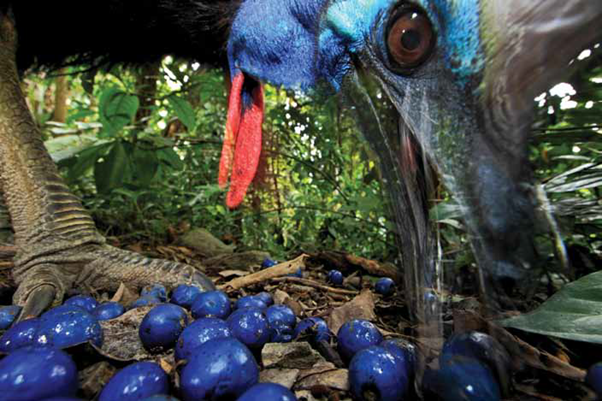
In contrast, the enigmatic elocarpus or blue quandong seed (right; photo from Harms & Green, 2014) are blue to a point where they are iridescent yet the skin of these friut does not contain much in the way of nutritional value. Nor does it contain a single molecule of blue pigment!

The Pollia condensata fruit from Africa performs that same trick, an eye-catching iridescent blue, more intense than that of any previously described biological material, created without the aid of blue pigment (seriously click the link it’s a beautiful fruit).
What is actually occurring on the skin of these seeds is a complex bending and refracting of white light to create blue iridescence. This is achieved by taking lines of cellulose (the basic building block of all plant matter) called microfibrils and arranging these lines side-by-side into planes. The planes of microfibrils are then in turn arranged in helicoid stacks. The complex architecture refracts light creating an intensely iridescent blue. This is much the same process that creates the iridescence seen in the blue wing of the Papilo ulessus butterfly which gently drifts through the canopy above us as we work. It seems like a complicated process just to make blue, but the aim of these seeds is to trick seed disperses (birds and critters) into taking the seed for little or no nutritional return. To pull off such a trick I guess you need to be a pretty special looking blue.
Dispersal strategy and staying power
In the rainforest a plant faces an interesting conundrum when it come to the choice of seed that it creates. We know that seeds that disperse farther away from their parent tree, and their brother and sister seedlings, tend to have a better chance of surviving (see post 2) so there is an advantage to having a guaranteed dispersal strategy. This is exactly what winged seeds do. They use the wind to carry seeds far from the parent tree. In the image at the top of this post there are two winged seed morphologies. The flaky brown seeds, which an onlooker quite astutely described as ‘sweet-potato chip’ seeds, see-saw clumsily down to the forest floor. These are the seeds of Cardwellia sublimus. The pod full of winged seeds with yellow dust over the seed (it’s not pollen) fly like helicopters through the under-story. These are the seeds of a Lomatia tree.
There are many tree species with winged seeds in rainforests, but by and large rainforest seeds take the form of large fleshy fruits, many of which contain one seed per fruit. When these seeds leave the mamma tree, their nursery ground immediately rises to meet them with a resounding ‘thunk’. That is, they pretty much fall straight down. They might roll down the hill a bit if the parent tree is growing on a steep enough slope. But largely there is not much dispersal happening during the journey from canopy to ground. So why are so many rainforest tree species sacrificing their dispersal ability in favour of these mighty conkers? It seems like a lot of energy must go into making such large seeds. And there’s the answers. Energy. When you cut open one of these seeds, you’ll find two large fleshy halves. These are actually the seeds first leaves. They look nothing like any of the leaves that will follow, they are not true leaves, they have special name ‘cotyledons’ and they are energy reserves.

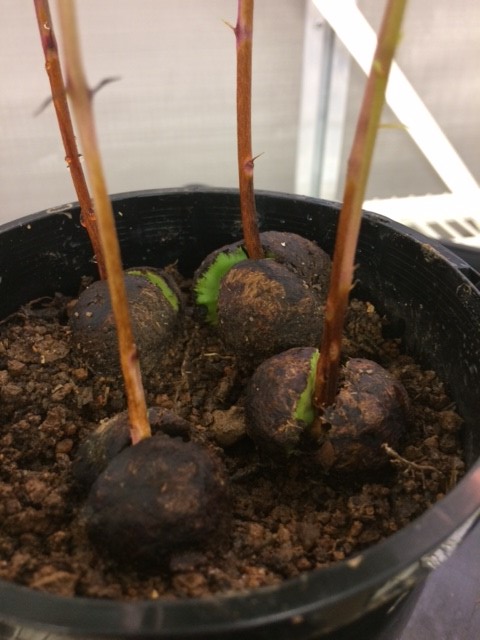
Cotyledons of a winged seed are thin and designed to photosynthesize (above left); Golf-ball sized fleshy cotyledons from large seeds remain at the base of the seedling with a very minimal for photosynthesis (green area).
The cotyledons of winged species are thin, emerge and disappear quickly and are almost entirely used for harvesting light into energy. In contrast the cotyledons of large-seeded species hang around for a long time but contribute little towards photosynthesis – some even stay encased in their seed coat. These cotyledons are energy reserves. The idea is that in a rainforest for a seedling to survive and become a tree it needs to persist for a long time. It needs to persists even though there is extremely low light, it needs to persist even if leaf litter covers its photosynthetic leaves and it needs to persists -and re-sprout – if its shoot gets eaten. It may need to wait a very long time because things the rainforest under-story happen sloooowly, so having a storage reserve confers a selective advantage (Green and Juniper, 2004).
‘How slow?’ I hear you ask. Well, for more then 50 years ecologists have painstakingly tracked the growth of thousands of seedlings, sapling and trees at Davies Creek: in that 50 years some plant have only grown few feet (Harms and Green, 2014).
So it seems survival in the dark is the order of the day for rainforest seedlings and large seeds which come with a packed lunch of energy reserves are one way to help the seed manage this suppressive environment. In terms of dispersal – not all is lost – these seeds simply outsource the job. The fleshy, and often fragrant, outer coverings of the fruit attract cassowaries and other native animals such as the white tail rat which will redistribute the seeds around the forest. The rats create caches of seeds that if forgotten long enough will germinate, and cassowaries leave steaming seed patties in the wake of their wanderings. Dispersing seeds, encouraging diversity and making seed collection for this ecologist as simple as poo-pie.


Ask not: Can you eat that seed? | Ask: What can that seed tell you?
Dr Jen Wood
@JW_ilikedirt
All thoughts and photos by Jen Wood unless otherwise indicated
Green, P.T. and Juniper, P.A. (2004). “Seed–seedling allometry in tropical rain forest trees: Seed mass-related patterns of resource allocation and the ‘reserve effect’.” Journal of Ecology 92(3): 397-408.
Harms, K.E. and Green, P. T. (2014). “Under the lunch tree: 50 years of rainforest dynamics in Queensland, Australia.” Natural History March 2014


 microfiles.home.blog
